CONTRADICTIONS

CONTRADICTIONS

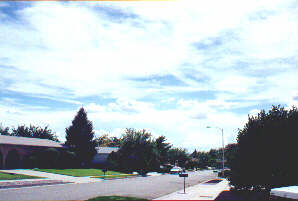
A contradiction is examined in this paper where, despite conditions being unfavorable to the formation of clouds, heavy aircraft spray activity in the morning hours in Santa Fe, New Mexico resulted in the classic formation of extensive cirrus-, cirrostratus-, and cirrocumulus ‘appearing’ cloud decks at a relative humidity of 36%. Six reliable sources, including researchers at NASA and NOAA, and Vincent Shaefer (inventor of cloud seeding in 1946), affirm that cloud formation is not expected to even begin below relative humidities of 70%. And yet repeatedly since the early part of 1999 such formation of cirrus - cirro-stratus - and cirrocumulus cloud decks are observed forming as a direct result of aircraft activity in conditions of extreme low humidity in the southwest desert.
EPA REFUSES TO IDENTIFY SAMPLE

EPA REFUSES TO IDENTIFY SAMPLE

A letter from the Environmental Protection Agency (EPA) to Clifford Carnicom states the intention of the EPA is to not analyze the samples sent to them by Mr. Carnicom previously. Rather, they attached their same letter of refusal from earlier in the year that describes their view that aerosols and such programs do not exist, and that it is normal contrails that are showing in the skies that people are reporting.
EPA DEEMED NEGLIGENT

EPA DEEMED NEGLIGENT

A copy of a certified letter sent by Clifford Carnicom on June 9, 2000 to Carol M. Browner, the Administrator of the Environmental Protection Agency (EPA), is attached in this paper that outlines how Ms. Browner has been negligent in not investigating and analyzing hazardous biological samples sent previously to the EPA that pose human health risks. This letter makes clear that Ms. Browner and the EPA are responsible for reporting to the American public, and having not been forthcoming with an interest to look into the requests for sample analysis, Ms. Browner and the EPA are to be held accountable for the lack of integrity of the EPA.
AN AIRLINE MANAGER’S STATEMENT

AN AIRLINE MANAGER’S STATEMENT

After reading the account of the airline mechanic in the previous Carnicom paper titled “A MECHANIC’S STATEMENT (dated May 19, 2000), an anonymous upper level manager from an unnamed airline was compelled to write to Clifford Carnicom. He stated that the mechanic’s story was true, and that he had information regarding this airline’s participating in Operation Cloverleaf, which is known to be a military aerosol operation. He and other workers were briefed on this operation, background checks were performed on everyone involved, and they were forced to sign a non-disclosure agreement stating that if they said anything about the program they could be imprisoned. They were informed that the government was going to pay the airline to release special chemicals from the commercial aircraft. When asked what the chemicals were, they were told this was on a need to know basis only. They were also told that there weren’t enough military aircraft to spray these chemicals, which was why the commercial airlines were paid to release these chemicals. This was the main reason Project Cloverleaf was put into existence. The manager expressed grief for being involved in something that he felt was poisonous, and apologized for needing to maintain anonymous.
BIOLOGICAL COMPONENTS IDENTIFIED

BIOLOGICAL COMPONENTS IDENTIFIED

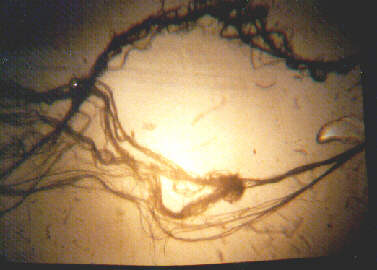
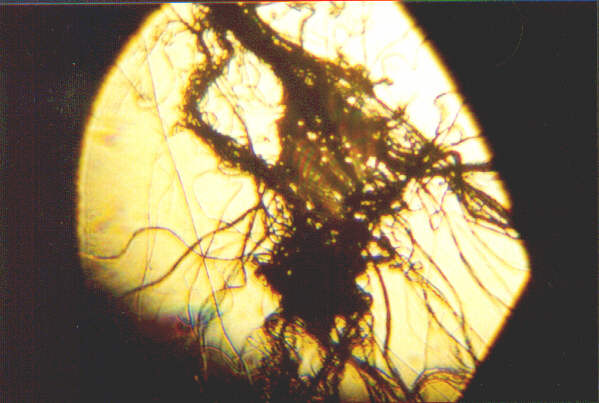
Further testing of ground fiber samples previously collected and analyzed (see papers titled AEROSOL GROUND SAMPLES) revealed biological components in the fibers - numerous red blood cells, white blood cells, and unidentified cell types have been found in the ground samples. The red blood cells, readily visible after being subjected to immersion oil, appear to possibly be of a freeze dried or desiccated nature. Numerous pictures from the microscope video show these biological as well as unidentified components. The surfaces of the cells appear to be modified in some way, but electron microscopy will likely be required to establish further detail.
ULTRAVIOLET LIGHT INVESTIGATIONS

ULTRAVIOLET LIGHT INVESTIGATIONS

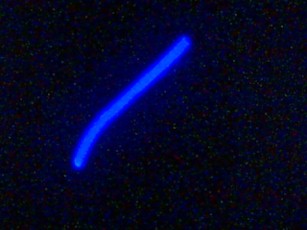
A ground fiber sample received previously in November 1999 is observed and pictured in this paper under a microscope and black light, and is compared to other known and unknown synthetic fibers. A notable thing from this observation is that the ground fibers show a low level of fluorescence, whereas the synthetics compared to show a high level of fluorescence. The ground fiber samples also showed sub-micron diameter, and high levels of adhesiveness and elasticity. Additional data and feedback of the current investigations underway with UV light is most welcome.

A CITIZEN’S CHRONICLE OF INQUIRIES

A CITIZEN’S CHRONICLE OF INQUIRIES

This page is a documentary as to the number of mailings that have been sent to politicians, television stations, the California Attorney General, the EPA and others by one Rick Moors. Mr. Moors also chronicles how many replies he has received, and each of Mr. Moor’s letters sent and received are included in this page. Each of the replies contains the standard ‘these trails are normal’ verbiage.
MICROSCOPIC PARTICLE COUNT STUDY NEW MEXICO 1996-1999

MICROSCOPIC PARTICLE COUNT STUDY NEW MEXICO 1996-1999

Driven by repeated observations of aerial spraying in the United States in the years from 1996-2000, a statistically significant study of airborne microscopic particle count data from the State of New Mexico was conducted, with approximately 175,000 observations of hourly monitored data from five stations in the state analyzed. This statistical test has been designed to question the difference between the data of 1999 (Data set 1) vs. the combined data of the three previous years from 1996-1998 (Data set 2). The results show that there is a significant statistical difference between the magnitudes, averages, and variances of the two data sets. The conclusion to be reached from this study is that the microscopic air particle count in the state of New Mexico in 1999 is significantly different from that of the preceding three years, and that this difference is directly correlated with the observations of aerial spraying that have taken place during this same time period. The results of this study form a further basis for criminal investigation of the documented spray activity and for congressional hearings on this subject.
EPA CONTINUES TO BE ‘UNAWARE’

EPA CONTINUES TO BE ‘UNAWARE’

A lengthy letter from the EPA, sent to a concerned citizen and copied on this page, is a complete denial of the possibility of aerosols and aerosol operations. The letter speaks a common theme of denial that the spray lines, witnessed by an increasing number of people and spreading out across the sky, are simply normal contrail exhaust from aircraft engines.
UNIVERSITY OF MICHIGAN CLASSIFIES INQUIRY AS ‘HARASSMENT’

UNIVERSITY OF MICHIGAN CLASSIFIES INQUIRY AS ‘HARASSMENT’

University of Michigan Correspondence with Individual Seeking Information on Nano Technology Research Program: TIME LINE OVERVIEW: 1. Letter to Dr. Jones - DARPA - Nov. 15th from A. C. Griffith. 2. Reply from the Director of DARPA, Lawrence H. Dubois, Nov. 16th to A.C. Griffith. 3. A.C.Griffith made one telephone call and one e-mail to Univ. of Mich., News and Information Service, Ann Arbor, Michigan, Nov. 17th. 4. E-mail to A.C. Griffith received from Officer Sura on computer in Winston-Salem. 5. Telephone message to A.C. Griffith on answering machine in Richmond from Officer Sura, University of Michigan, sometime between Nov. 19 and Nov. 21, 1999. 6. Reply letter to Officer Sura dated Nov. 22, 1999.
AEROSOL GROUND SAMPLE: MICROSCOPIC VIEWS

AEROSOL GROUND SAMPLE: MICROSCOPIC VIEWS

Microscopic views are presented of two filaments taken from a ground fiber sample after aerial spraying in eastern Oregon on November 2nd and November 4th, 1999. Observation and analysis indicate that the samples appear to be a polymer of some type, being both extremely elastic and adhesive, raising the possibility that this material may act as a carrier mechanism. The materials are white, and look like spider webs. The materials, under magnification, show individual strands that are wave-like in nature, and tend to coalesce and congeal easily. Ill health effects have been reported in association with the handling of this material. This material is reported to dissipate within a few hours of falling on the ground, and in being exposed to the weather. The ground fiber sample images are compared to and found not to be spider webs, and to be fully synthetic. Common health effects associated with this spraying include severe respiratory problems, burning eyes, feeling tired, and some people coughing up blood.